
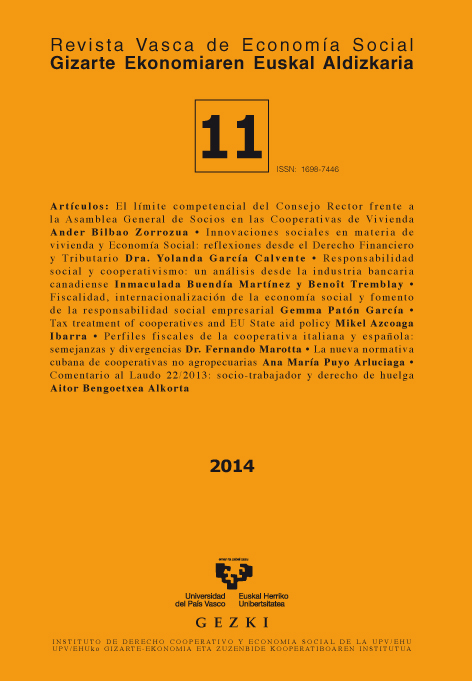
Fiscalidad, Internacionalización de la Economía social y fomento de la responsabilidad social empresarial
##plugins.themes.bootstrap3.article.main##
##plugins.themes.bootstrap3.article.sidebar##
Resumen
La crisis económica ha generado una mayor preocupación en los países desarrollados por el control de los riesgos sociales con efectos negativos sobre el crecimiento y este problema puede abordarse desde la perspectiva de la RSE. De este modo, la RSE se observa como la actitud empresarial dirigida a promover fines sociales, económicos y ambientales a la vez que garantizar la competitividad en el mercado internacional. Así, la economía social puede contribuir al desarrollo sostenible, a la cohesión económica y social, a fomentar el tejido productivo y la distribución de la renta, a favorecer el empleo y a procurar la igualdad de oportunidades.
El objeto del presente estudio pretende incidir en el papel que la fiscalidad desempeña en el área de la incentivación de políticas relacionadas con la economía social y que muy destacadamente se manifiesta en el régimen jurídico de las cooperativas.
En efecto, la importancia de ofrecer un marco legal y fiscal de promoción de su internacionalización se cohonesta de forma providencial con los principios que gobiernan la acción cooperativista. Desde nuestro punto de vista, es indispensable desde la perspectiva del desarrollo sostenible y la responsabilidad social de las cooperativas que se tome en consideración en el régimen fiscal aplicable criterios que puedan justificarse en los principios constitucionales, el interés general de la sociedad o de internacionalización de la actividad económica. Asimismo, podrían conseguirse otros efectos positivos en el área de América latina como la disminución de la evasión fiscal y la formalización de al menos una parte del sector informal de la economía, incluso el impulso a la auténtica RSE y, por ende, en los objetivos de economía sostenible.
Cómo citar
##plugins.themes.bootstrap3.article.details##
Los autores y autoras que publican en la revista GIZAEKOA – Revista Vasca de Economía Social aceptan los siguientes términos:
- Las personas autoras conservan todos los derechos de autor de sus trabajos, pero también otorgan derechos de autor a la editorial académica (UPV / EHU Press) con fines de gestión de derechos de autor o autora, vigilancia y protección.
- Los documentos se publican por defecto con una licencia de atribución CreativeCommons CC-BY no restrictiva, que permite a otros usar y compartir el papel de forma ilimitada, con la condición de que la autoría, la fuente y el DOI correspondiente se especifiquen en las proximidades del material reproducido, por ejemplo, de la siguiente manera:
Bengoetxea Alkorta, Aitor; Villafáñez Pérez, Itziar (2020). «Euskadiko Kooperatiben Lege berria», GIZAEKOA - Revista Vasca de Economía Social, 17, 197-224. (https://doi.org/10.1387/gizaekoa.22233).
- Si un autor o autora requiere una licencia CC más restringida (por ejemplo, CC-BY-SA), puede proporcionarla contactando a nuestra editora en: publicaciones@ehu.eus
- En particular, y sin tener que solicitar un permiso adicional, los documentos con licencia CC BY pueden depositarse en repositorios institucionales y sitios web académicos, o volver a publicarse en libros, cuando se cumpla la condición de atribución mencionada anteriormente.
- "Post-prints" (versiones aceptadas pero no editadas del manuscrito): también se pueden publicar previamente en línea, siempre que se especifique el reconocimiento de la autoría y la fuente como se indicó anteriormente.
Para usos no estándar de artículos o materiales publicados en GizarteEkonomiarenEuskalAldizkaria – Revista Vasca de Economía Social, comuníquese con nuestra editorial UPV / EHU Press en: collections@ehu.eus