Proposals till 27 September 2026
About the Journal
The AusArt research journal aims to be a benchmark in research production in contemporary art, as a central place in the analysis of our culture. It is born with a multidisciplinary perspective where theoretical production and creative processes converge, with special emphasis on the participation and interaction of cultural and technological processes. AusArt magazine is conceived as a place for reflection and discussion, open to the entire artistic and university community.
Current Issue
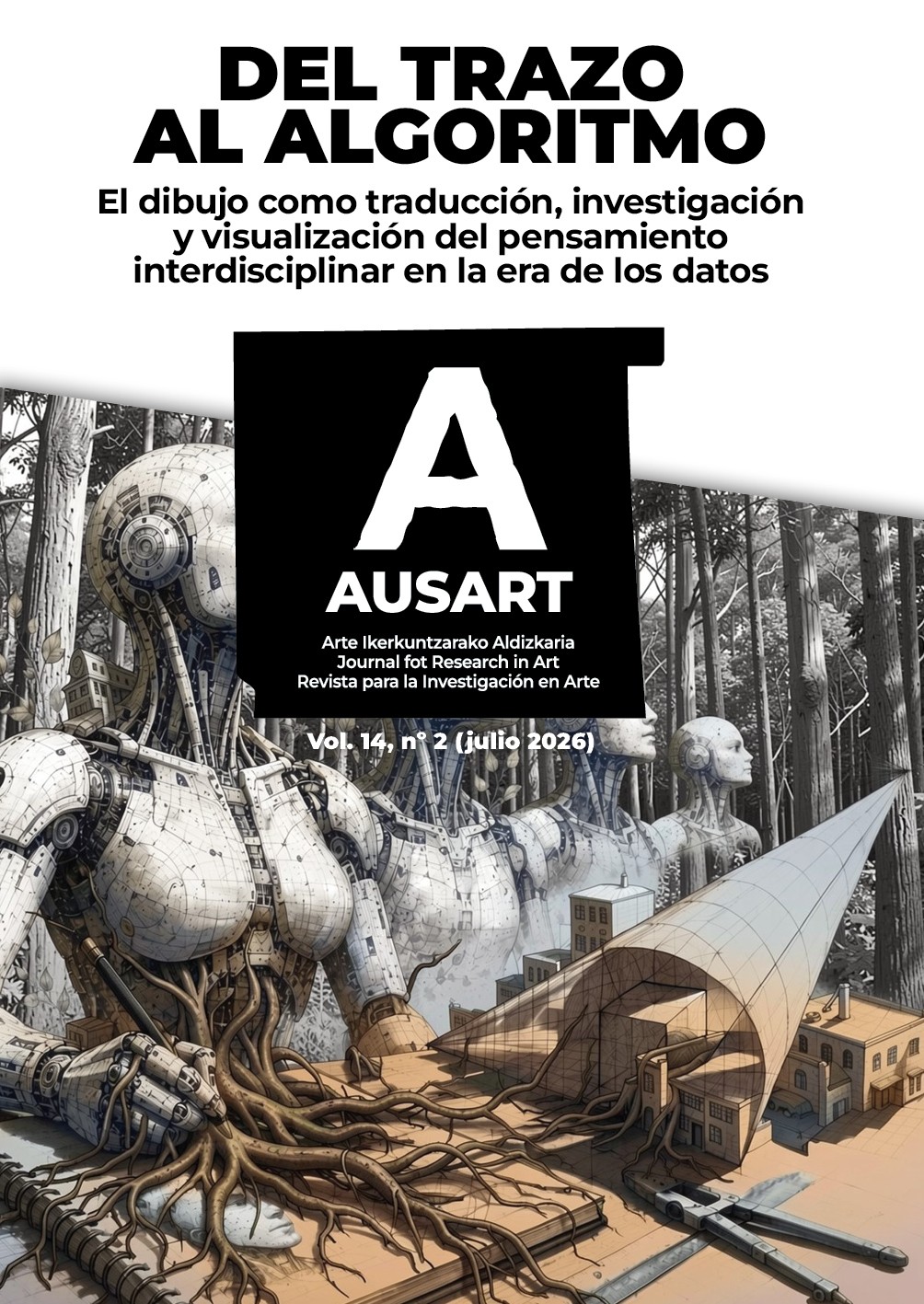
Transformations and new practices in contemporary drawing
Contemporary drawing has been expanding its traditional boundaries to become a space for research that spans disciplines, technologies, and forms of knowledge. It functions as a cognitive tool, a method of scientific exploration, a visualisation device, and a field of technological experimentation. This special issue brings together twenty-one articles grouped into five thematic strands that explore the relationships between drawing and interdisciplinarity, science, data, artificial intelligence, and cognition, offering a multifaceted view of the debates shaping current research from, through, and around drawing.
The articles provide an insight into the transformations drawing is undergoing in increasingly interdisciplinary contexts, highlighting its capacity to generate new ways of observing, understanding, and interpreting contemporary reality. We examine how drawing functions simultaneously as a medium of representation, a tool for thought, and a practice for producing knowledge, bringing together diverse theoretical approaches, case studies, and experiences from artistic and scientific research.
In the context of contemporary drawing —ranging from interdisciplinary approaches involving science to scientific illustration— the significant role of drawing is well established, underscoring its latent potential as a medium for exploration, representation, and the visual communication of knowledge. Both areas, traditionally associated with scientific and educational outreach, have become increasingly integrated into artistic research, opening up new possibilities for visual analysis, graphic experimentation, and the generation of interdisciplinary knowledge. In the field of interdisciplinary research, drawing becomes a methodological tool that enables processes to be recorded, ideas to be visualised and both abstract and material relationships to be represented. Beyond its representational function, drawing fosters a form of visual thinking that integrates analysis, synthesis, and creativity; it ceases to be merely a means of expression and becomes a device for thought, detailed observation, and the production of visual knowledge. Thus, in this context, the monograph opens with a text by José Luis Ortega Lisbona and Olga Martí Prades, which analyses, identifies, and perceives invisible dynamics: the tensions generated between performative experience and algorithmic abstraction, through two practice-based research projects situated in El Cabanyal and another centred on Times Square. Within the same framework, José Ignacio Lorente proposes drawing as a performative practice, raising pertinent questions about the visible as a threshold where aesthetics and politics intersect. He explores artistic and interdisciplinary research into drawing within the context of dance, questioning movement and performative intervention in sociocultural and urban spaces. Miriam González Álvarez’s article outlines three actions inspired by Hundertwasser that address the so-called ‘three skins’: the sociocultural, the identitarian, and the collective. To this end, artistic-educational experiences are developed with Year 9 pupils, aimed at constructing narratives of identity through shared corporeality. The results demonstrate the potential of drawing to stimulate critical, bodily, and relational processes in educational contexts.
Set within the parameters of scientific observation, Arianne Garrido Quilis’s text explores the visual and conceptual potential of interference patterns generated by polarised light in birefringent plastic materials subjected to tension, producing graphic records that condense the invisible dynamics of stress —perceived through experimentation with light— in which drawing materialises as a record of this experimentation. For his part, Albert Alcoz analyses the preparatory sketches or diagrams created by filmmakers and visual artists such as Toshio Matsumoto, Malcolm Le Grice and Madison Brookshire, as a potential for an alternative approach to scriptwriting or film projects, in which drawing on paper reaches its zenith as a formalist proposal aligned with structural, minimalist, or systematic cinema.
Scientific illustration, characterised by its precision, objectivity, and technical rigour, has historically been used to represent elements of the natural and scientific world—such as organisms, anatomical structures, biological processes, or geological phenomena—with a high degree of accuracy. However, in contemporary drawing, this practice has transcended its traditional boundaries, becoming a means of reflecting on perception, representation, and the relationship between art and science. Artists and visual researchers employ scientific illustration as a critical strategy to question how we observe and understand our environment. The capacity of drawing to organise and prioritise information has been harnessed by artist-researchers seeking to explore non-linear narrative structures, establishing connections between visual concepts and constructing graphic languages that challenge the boundaries between the scientific, the artistic, and the communicative. Numerous contemporary projects demonstrate this convergence. For example, artistic projects that document biodiversity from both aesthetic and scientific perspectives, or graphic research that translates social and ecological phenomena into visual systems that combine real data with formal solutions characteristic of art. These practices occupy a hybrid territory, where informational rigour coexists with artistic subjectivity, and where drawing functions as an interface between disciplines. In this context, we present an article by Laura Fernández Gibellini and Ricardo Horcajada González, who reflect on fiction and consensus in the production of scientific knowledge through its visual representation. Scientific evidence, in its performative phase, enables models for constructing reality that ultimately become scientific knowledge through drawing. For her part, Lena Peñate Spicer offers a reflection on ‘expanded drawing’, utilising tools in which the objectivity of data recording, combined with subjectivity in the collection of empirical data and social constructs, provides us with a new avenue for a situated and critical re-reading of the analysed facts. From another perspective, Nuria Sánchez-León, Olga Mayoral García Berlanga and Matilde Portales Raga champion drawing as a means of data collection in contrast to written narrative, asserting that it is a more effective interdisciplinary tool for the detailed translation and representation of scientific observations, and highlighting its high methodological potential for promoting meaningful scientific learning amongst students. Finally, this section includes the article by Adrián Vilar Martín and Daniela Concepción Castanedo, which explores the redefinition of methodological freedom in artistic research. To this end, they justify the value of drawing analogies between art and science through the biological metaphor of thanatokresis, enclosing our soft body —the drawing— within a borrowed exoskeleton, in this case, quantum physics.
In the articles brought together in the third section, data visualisation emerges as fertile ground where the intersection of graphic languages, algorithmic technologies, and fields of knowledge multiplies its potential as a tool for analysis and critical engagement. In his article, Chema Bullón de Diego addresses the reconfiguration of drawing within today’s data-driven culture. Through diagrammatic language, a bridge is established between line and algorithm, materialising a structural continuity between the past and future of the cognitive regimes of the gaze. In line with this approach, Rita Cisnal Herrero explores the transformation of the designer into an architect of dynamic systems, analysing how drawing in the field of fashion design has evolved into a system capable of visualising bodily data, thanks to the integration of algorithms and related technologies into creative processes.
Bringing this section to a close, José Antonio Vertedor Romero presents drawing as a device for perceptual and cognitive translation and investigates the reconfiguration of drawing as a multisensory and somatic process. The author sonifies the line using the experimental system «Neuro Sonic: Draw Synthesis», which integrates the recording of brain activity and its synchronisation with microacoustic signals of movement.
The five articles brought together in the fourth section share a cross-cutting theme: reflecting on drawing and the image in a context where creative processes are interwoven with data, algorithms, artificial intelligence, and systems of translation between the sensory and the computational. From different perspectives —generative installation, real-time drawing with AI, and assisted compositional analysis— the texts propose an interpretation of drawing as an expanded practice, capable of mediating between perception, information, gesture, interpretation, and human agency. This theme is introduced by Elena Mir Sánchez’s article, in which she positions the generative multimedia installation as a space where art, science, and technology intersect. The text explores the notion of the ‘expanded stroke’ as its conceptual core: a stroke that is no longer limited to the graphic line, but acts as a dynamic record of data, natural processes, mathematical patterns, scientific information, or emotional states. The generative installation is presented as a device capable of revealing phenomena that are almost inaccessible to direct perception and transforming them into visual, auditory, or interactive experiences. Furthermore, Mario Casanova Ivanco, Laura Garcés Fernández, and Francisco José de la Torre Oliver analyse the relationship between human gesture and the algorithmic image in real-time creative environments. Drawing on the case of Krea, the article examines how drawing can serve as an initial input that AI translates, transforms, and expands through generative processes. The crux of the text lies in distinguishing human creativity —which is affective, intentional, symbolic and evolutionary— from the probabilistic logic of AI. The machine expands the field of visual possibilities; the human retains conceptual direction, critical judgment, and symbolic responsibility throughout the process. Joseba Koldobika Cejudo Estévez then extends this reflection to the pedagogical and methodological sphere. The article draws on a workshop with 74 visual arts students in which Claude was used to analyse their own compositions. The process shifts the analogue perspective towards forms of visual translation based on data, tables, heatmaps, and SVG representations. The results show a high level of overall satisfaction and a clear appreciation of human involvement, although originality emerges as a more problematic dimension. The text also proposes a Responsible Integration Protocol for the critical incorporation of AI into art education. Next, Ángel Fernando Cano Esparcia and José Mayor Iborra analyse the Fisuras project to explore how drawing can make emotional dimensions visible that are difficult to perceive directly. In their article, they position drawing as an interface between perception, emotion, visual analysis, and technology, which bridges artistic practice, FACS, and artificial intelligence tools such as OpenFace to analyse how certain gestures, facial tensions, and affective atmospheres remain recognisable following graphic translation. Finally, Javier Corzo Martínez, Manuel Drago Díaz Alemán and Jorge de la Torre Cantero offer a rhizomatic cartography to analyse the impact of generative AI on digital drawing. The article presents an open, mutable, and collaborative map, developed in Miro® and organised into three sections: creativity, agency and AI; philosophy of art, authorship and AI; and drawing and AI.
This approach enables us to visualise connections between art, technology, authorship, the labour market, and the practice of drawing, offering a flexible model for studying still-ununderstood transformations. Taken together, the five articles trace a highly topical map of the tensions between creation, technology, and agency. Drawing emerges as a field of mediation between the visible and the invisible, between the body and the algorithm, between perceptual intuition and structured data. Technology is not presented as a replacement for human creativity, but rather as an environment for collaboration, translation, and productive conflict. The most significant common thread is the defence of active human agency: observing, deciding, interpreting, correcting, guiding, and making sense of increasingly complex processes mediated by intelligent systems.
In the fifth and final section, the articles address a common theme: the role of drawing in cognition. In a contemporary context in which technological mediation intervenes at every level of our perception and cognition, it is particularly urgent to rethink the capabilities of drawing. The articles collected here position drawing as a mediator both between fields of knowledge and between the materiality of the line and technology. María Gárgoles Navas opens the discussion; in her article, she analyses how the cognitive functions of drawing are transformed and expanded in the contemporary world, thereby maintaining its role as a bridge between art, science, and technology. To this end, she examines the functions of three manifestations or cognitive modes: drawing itself, scientific images, and data visualisation. Next, Ignacio Tejedor López presents drawing as a research practice for making the latent qualities of objects visible, deploying an experimental strategy that produces graphic traces that, in turn, reveal drawing as a mode of thought that generates meaning. For her part, Nerea Cordeiro Cerviño employs a notion of ‘expanded drawing’ in her own artistic practice, through which she links issues relating to material thought, the role of the body as an active interface, fabric as a structural model of thought, and the spider’s web as a privileged metaphor for interconnected systems. This exploration of the transformations of drawing is rounded off by the article by Absalón Rincón Muñoz, César Augusto Mateus Medina, Paola Angélica Castro Salazar, and María Angélica Martínez Wandurraga, which proposes understanding drawing as a mediating operation between situated experience, graphic synthesis, and digital formalisation. Through an analysis of character design in digital animation, they demonstrate how manual gesture and the digital environment influence one another, highlighting the cognitive operations mediated by drawing.
In conclusion, the articles brought together in this special issue enable us to understand contemporary drawing as a rapidly expanding field of research that intersects with science, technology, data, artificial intelligence, art education, and cognitive processes. Throughout the five sections, drawing emerges as a practice capable of observing, recording, translating, interpreting, and producing knowledge through diverse languages, whilst maintaining a close relationship with gesture, perception, the body, and situated experience. The contributions gathered here demonstrate that drawing now occupies a strategic position in debates on the image, visualisation, technological mediation, and creative agency. Its capacity to connect the sensory and the conceptual, the material and the digital, the intuitive and the analytical, makes it a particularly fertile tool for reflecting on the transformations of contemporary visual culture. Against this backdrop, drawing asserts itself as an open, critical, and cross-disciplinary practice, capable of engaging in dialogue with other fields of knowledge and fostering new forms of understanding in an era characterised by complexity, hybridisation and the growing presence of intelligent systems.
Nerea Legarreta Altzibar1
Lourdes de La Villa Liso2
Cristina Miranda de Almeida3
(1) EHU. Drawing Dept
(2) EHU. Drawing Dept. Intra_Natura. Artistic Intra-actions research group
(3) EHU. Drawing Dept. Intra_Natura. Artistic Intra-actions research group
Published: 2026-07-14
Drawing the invisible
Abstract 844 | PDF (Español (España)) Downloads 183From the stroke to the drift
Abstract 749 | PDF (Español (España)) Downloads 106The body as territory
Abstract 1121 | PDF (Español (España)) Downloads 132«Stress drawings»
Abstract 726 | PDF (Español (España)) Downloads 107Drawing structural film
Abstract 857 | PDF (Español (España)) Downloads 140The spatial localization of the world
Abstract 611 | PDF (Español (España)) Downloads 111Drawing, archive, and landscape
Abstract 637 | PDF (Español (España)) Downloads 116OBA, attentive botanical observation through drawing for the multimodal learning of future teachers in the digital age
Abstract 489 | PDF (Español (España)) Downloads 102Self made and then some
Abstract 1211 | PDF (Español (España)) Downloads 102Of drawing and the data
Abstract 619 | PDF (Español (España)) Downloads 116Expanded drawing as bodily data visualization system in contemporary fashion
Abstract 1290 | PDF (Español (España)) Downloads 99Sonic trace and neurogestural algorithmic systems
Abstract 724 | PDF (Español (España)) Downloads 106Making the invisible visible
Abstract 1485 | PDF (Español (España)) Downloads 133Collaboration between human creativity and generative artificial intelligence in the context of real-time drawing
Abstract 926 | PDF (Español (España)) Downloads 114From analogue vision to vector data
Abstract 1090 | PDF (Español (España)) Downloads 118Drawing as an Interface for emotional translation
Abstract 1334 | PDF (Español (España)) Downloads 115The rhizome as a cartographic model for the study of the implications of generative artificial intelligence in digital drawing
Abstract 639 | PDF (Español (España)) Downloads 138Drawing as a cognitive mediation technique
Abstract 956 | PDF (Español (España)) Downloads 172Drawing as practical thinking
Abstract 1276 | PDF (Español (España)) Downloads 100Weaving as process and form of material thought
Abstract 986 | PDF (Español (España)) Downloads 109Territory, trace, and software
Abstract 1226 | PDF (Español (España)) Downloads 161- Vol.14, No.2 (2026)
- Vol.14, No.1 (2026)
- Vol.13, No.2 (2025)
- Vol.13, No.1 (2025)
- Vol.12, No.2 (2024)
- Vol.12, No.1 (2024)
- Vol.11, No.2 (2023)
- Vol.11, No.1 (2023)
- Vol.10, No.2 (2022)
- Vol.10, No.1 (2022)
- Vol.9, No.2 (2021)
- Vol.9, No.1 (2021)
- Vol.8, No.2 (2020)
- Vol.8, No.1 (2020)
- Vol.7, No.2 (2019)
- Vol.7, No.1 (2019)
- Vol.6, No.2 (2018)
- Vol.6, No.1 (2018)
- Vol.5, No.2 (2017)
- Vol.5, No.1 (2017)
- Vol.4, No.2 (2016)
- Vol.4, No.1 (2016)
- Vol.3, No.2 (2015)
- Vol.3, No.1 (2015)
- Vol.2, No.2 (2014)
- Vol.2, No.1 (2014)
- Vol.1, No.1-2 (2013)