
Vol. 14 No. 1 (2026): Emotional discourses in art and visual culture
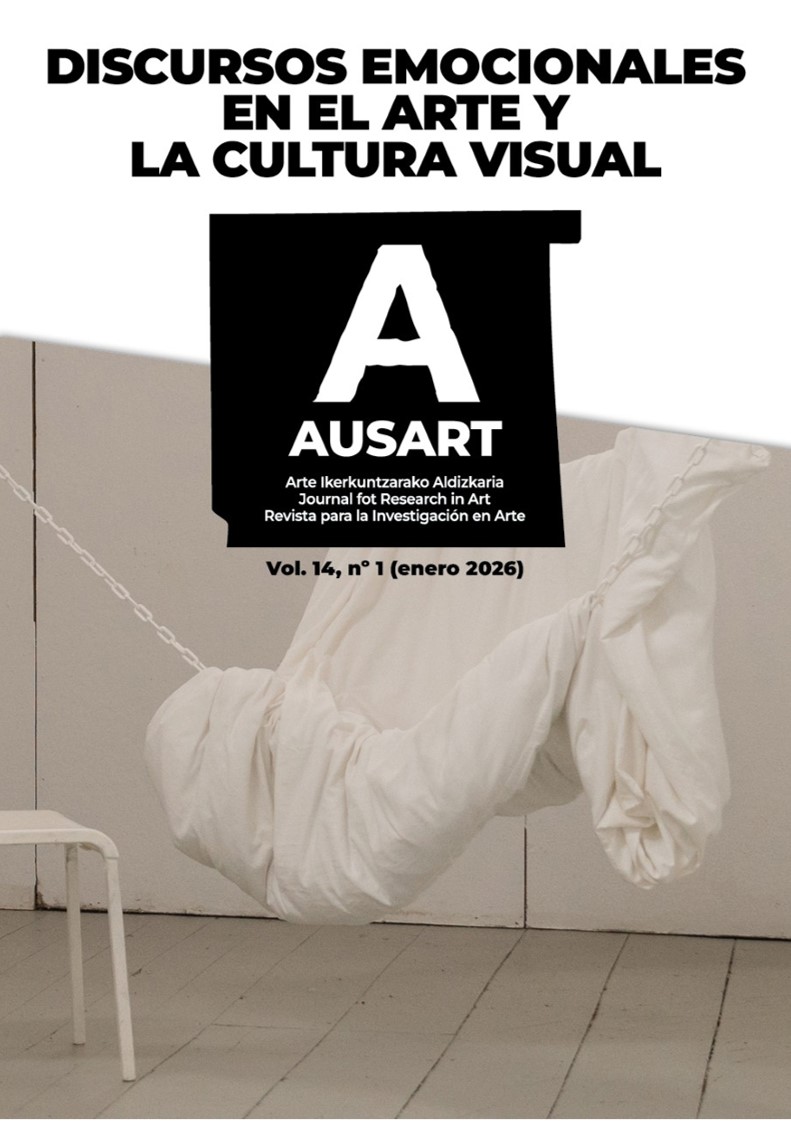
This issue of the journal is part of the growing academic interest in studying the emotional discourses that unfold, are reproduced, diluted, or negotiated in different visual and artistic media. Set mainly in the historical context of postmodernity, from 1970 to the present, the volume brings together contributions from art history, artistic research, visual culture, and film history.
Broadly speaking, there are two main themes that structure this issue. On the one hand, it reflects on the role that various visual media, such as contemporary art, audiovisual media, and cinema, have played in the construction, dissemination, and reproduction of certain emotional narratives, as well as in the configuration of figures or archetypes laden with affective connotations, such as the mother, the monster, or flies. On the other hand, it explores how these same visual devices have explored new strategies of appropriation, negotiation, or resistance in the face of dominant emotional discourses.
The volume opens with a text by Leire Ituarte Pérez, who studies the maternal figure in the film Furtivos (José Luis Borau, 1975) in relation to the gender and family ideals of Francoism, proposing that this character also functions as a metaphor for the socio-political breakdown that was taking place at the time. In dialogue with a similar context, Nuria Cancela López and Edurne Larumbe Villareal introduce us to another line of research within the field of cinema: star studies. Following the career of internationally successful actress Lucia Bosé, they analyze how the unhappy female characters she played in the late 1960s responded, to a large extent, to the actress's own will and, therefore, to her desire to destabilize the normalized discourses on marriage and female duty. Ana Belén Feijoó Valencia's work is set in the same chronological framework, studying the artistic production of sculptor and jeweler Carole Ramis. As these pieces were conceived as protective talismans, it is suggested that they also condensed collective affections such as the search for hope in a period of political and social uncertainty.
Fast forwarding to the present day, Sara Piñeiro Fernández examines how, in the hypervisuality of the digital age, contemporary artists' self-construction of their own image has taken on a new dimension, including an emotional one. The author examines some of the strategies of emotional exposure that are repeated on social media. For their part, Galo Vásconez Merino and Antonella Carpio Arias explore the emotions present in another visual territory. Their analysis of three recent road movies allows them to delve into the affective dimension of these cinematic journeys.
Among the articles that explore the emotional dimension of the monster archetype is the work of Mónica Sánchez Tierraseca, who, based on the film The girl with the needle (Magnus von Horn, 2024), analyzes different figures in the work and their affective narratives in relation to their historical configuration. ‘Monstrosity’ is also studied in the article by Francisco Gómez Díaz, who analyzes the audiovisual piece «La mala pintura» (Carles Congost, 2008), focusing on its formal and affective components and how these contribute to its critical dimension. In Concepción Cortés Zulueta's article, we see the monstrous transferred to insects. In her research, the author analyzes negative feelings towards flies through different milestones, taking into account the gender dimension and advocating the need to renew our appreciation for beings such as these.
In relation to the resilience and persistence of affectivity, in his article Ezequiel Lozano studies the miniseries La mesías (Javier Calvo & Javier Ambrossi, 2023) as a source of counter-normative iconography, highlighting how this type of audiovisual media activates affections in dialogue with popular archives. For her part, Patricia Bonnin-Arias examines the devices of bodily discipline in ballet, as well as their link to the romantic ideal in the films Las niñas de cristal (Jota Linares, 2022) and Black swan (Darren Aronofsky, 2010). Continuing with affections in dance, Irene López Arnaiz investigates the Nyota Inyoka archive, created by the dancer herself, in order to interpret her life's work from the affective dimensions that run through the documents collected.
Finally, this issue includes three articles that examine the construction of a specific emotion: nostalgia. Javier Leñador discusses emerging Spanish painting to see how nostalgia is expressed in certain specific works, offering a critical analysis that seeks to understand emotion as a cultural phenomenon. Another contribution along these lines is that of Sunyoung Park, who approaches photo-sculpture as an affective space for rethinking the relationships between memory, history, and survival, as a critical modality that reconfigures inherited emotional structures. Finally, Mariano Antonio Báguena Bueso, Miguel Rangil Gallardo, and Moisés Mañas Carbonell study the precarious digital aesthetics deliberately employed in contemporary video games to foster an emotional connection through nostalgia.
Ane Lekuona Mariscal
Maite Luengo Aguirre
Published: 2026-03-06